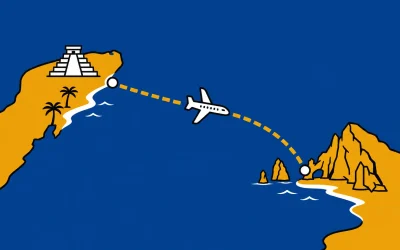

You can leave a beach lounger in Cancun at breakfast and be checking into a resort in Punta Cana by late afternoon. The trick is choosing the right flight, connection, and airport transfer so the day doesn’t turn into a 12‑hour slog.
This guide breaks down exactly how to get from Cancun to Punta Cana in 2026: distance, direct and connecting flights, real door‑to‑door timing, typical costs, transfer options at both airports, and smart booking strategies.
Cancun to Punta Cana: 2026 Overview
You’ll fly between Cancun International Airport (CUN) in Mexico and Punta Cana International Airport (PUJ) in the Dominican Republic. There’s no land or ferry route that makes sense here; it’s a pure air corridor across the Caribbean.
Key facts for 2026:
- Route: Cancun (CUN) → Punta Cana (PUJ)
- Direct flights: Yes, on select airlines (nonstop around 3 hours)
- Connecting flights: Widely available via hubs like Fort Lauderdale, Panama City, and San Juan
- Realistic door‑to‑door time: Around 6–10 hours, depending on connection and transfers
- Ground transfers: Reliable options at both airports, from budget buses/shuttles to private cars
If you’re planning a two‑country Caribbean vacation, this is a perfectly reasonable hop to include.
Distance and Geography: How Far Is Cancun from Punta Cana?
You’re crossing the Caribbean from Mexico’s Yucatán Peninsula to the eastern tip of the Dominican Republic.
- Approximate flight distance: about 1,000–1,100 miles (roughly 1,600–1,800 km)
- Time zone: Cancun usually runs on Eastern Time without daylight changes; Punta Cana is also on the same offset, so time difference is minimal or zero most of the year.
Because the route is relatively short, in‑air flight time is around 3 hours on a nonstop. The rest of your travel day is eaten up by check‑in, security, immigration, and transfers.
How to Travel: Direct, Connecting & Alternatives
Direct flights: airlines, schedules, duration
As of 2026 there are nonstop flights on the Cancun–Punta Cana route.
Nonstop operators mentioned in schedules
- Arajet
- Aerolineas Argentinas
Typical nonstop flight time
- Around 3h 00m to 3h 06m
Frequency
- Schedules show roughly 7 flights per week, often daily or near‑daily depending on the season and specific timetable.
Some general booking engines still claim there are “no direct flights,” but route‑specific schedule tools show these nonstops clearly. Always double‑check dates; carriers occasionally switch between seasonal and year‑round operation.
When a nonstop makes sense:
- You value time and simplicity over squeezing every last dollar.
- You travel with kids or bulky luggage and want fewer chances for bags to go missing.
- You prefer to avoid U.S. transit and extra immigration queues.
Connecting flights: common layovers, pros and cons
If the nonstop doesn’t run on your date or the fare is high, you’ll find many one‑stop options.
Common connection airports for CUN → PUJ include:
- Fort Lauderdale (FLL)
- Panama City – Tocumen (PTY)
- San Juan (SJU)
Airlines that appear in itineraries on this corridor in 2026 include:
- Aerolineas Argentinas
- Aeromexico
- Air Canada
- American Airlines
- Arajet
- Copa Airlines
- Delta
- JetBlue
- LATAM
- United
- avianca
- Plus ticketing intermediaries like World Ticket Ltd on some search sites
You may not connect through all of these carriers’ main hubs for this specific route, but they show up in booking engines selling CUN–PUJ itineraries.
Pros of connecting flights:
- Often more departure time options.
- Sometimes cheaper than the nonstop, depending on promotions.
- Can combine loyalty programs or status benefits if you’re tied to an alliance.
Cons:
- Longer travel day. Connection windows plus extra security and immigration can easily add 2–5 hours.
- Higher disruption risk. More flights = more chances for delays or missed connections.
- U.S. layovers add immigration and customs, even when simply transiting.
Are there cruise or ferry options?
No practical ferries or passenger boats link Cancun and Punta Cana in a way that competes with flying.
You could technically combine:
- Cruise from one region to the other, or
- Multiple flights plus a cruise leg,
but that’s an itinerary design project, not a transport alternative. For almost everyone planning a Cancun → Punta Cana hop, flying is the only realistic method.
Airports Guide: CUN and PUJ
Cancun International Airport (CUN): departure tips
Cancun is a busy hub with heavy resort traffic and sometimes chaotic queues, especially on weekends.
How early to arrive for CUN → PUJ:
- Nonstop international flight: Aim for 2.5–3 hours before departure.
- If you’re connecting onward via the U.S. with separate tickets, err closer to 3 hours.
Ground transport to CUN
From hotels or rentals, you’ll usually use one of:
| Option | Typical 2026 Cost | When it makes sense |
|---|---|---|
| ADO bus to downtown | 145–170 MXN (~$8–$10 USD) | Budget travelers staying near downtown or happy to taxi/Uber from there |
| Private transfer to Hotel Zone | $35–$65 USD per vehicle | Most comfortable for couples/families; fixed price; door‑to‑door |
| Taxi to Hotel Zone | $55–$90 USD | Walk‑up; usually pricier than pre‑booked; OK if you didn’t arrange ahead |
Example 2026 guide prices:
CUN → Hotel Zone
- Private transfer: about $45 USD
- Taxi: often $55–$75+ USD
CUN → Playa del Carmen
- Private transfer: about $80 USD
- Taxi: $80–$140 USD
CUN → Tulum
- Private transfer: about $155 USD
- Taxi: often $120–$200+ USD
Pattern: pre‑booked transfers beat walk‑up taxis on price and predictability.
Airport tips at CUN:
- Keep boarding passes and hotel confirmations handy; airport staff sometimes ask what resort you’re coming from.
- Food courts and lounges can be crowded; don’t count on a quiet work corner at peak hours.
- Duty‑free is large but not always cheaper than town; buy only if you’ve priced items before.
Punta Cana International Airport (PUJ): arrival and transfer tips
Punta Cana’s airport is compact and resort‑oriented. Many transfers are pre‑arranged through hotels or tour operators.
Immigration & customs:
- Expect lines when several widebodies land close together.
- Have your hotel address and return flight details ready.
Ground transport from PUJ
| Option | Typical 2026 Cost | Best for |
|---|---|---|
| Shared shuttle | $8–$25 per person | Solo travelers; those OK with multiple stops |
| Private transfer | $35–$75 USD per vehicle | Couples, families, groups; door‑to‑door convenience |
| Taxi | $30–$70 USD per vehicle | Short‑notice or if you skipped pre‑booking |
Destination examples:
PUJ → Bávaro
- Private transfer around $35–$40 USD (1–3 passengers)
- Shared shuttles roughly $15–$30 USD per person
PUJ → Cap Cana
- Private transfer often $25–$30 USD
PUJ → Uvero Alto
- Private transfer around $55–$59 USD
Pattern: shared shuttles are cheapest per person, private transfers are best value for small groups.
Arrival tips at PUJ:
- Ignore aggressive “information” desks trying to sell timeshares; walk straight through to the exit or your confirmed transfer desk.
- Confirm your transfer company and meeting point before you fly.
- Cash isn’t mandatory, but having small USD notes helps with tips and quick purchases.
Travel Time and Costs: What to Expect
Flight durations and layover impacts
Nonstop flights CUN → PUJ:
- In‑air time: about 3 hours
- Gate‑to‑gate schedule: around 3h 00m–3h 06m
Connecting flights:
Typical minimum connection planning
- International connection without re‑clearing customs: allow 90 minutes to 2 hours.
- If you must clear immigration and customs, then recheck bags: aim for 2.5–3+ hours.
A 2026 layover study for U.S. airports found average layovers around 3h 35m, ranging from about 2h 46m to 5h 8m. Many CUN–PUJ one‑stop itineraries land around that range.
Door‑to‑door reality
For a nonstop CUN → PUJ itinerary:
- Hotel in Cancun → CUN: 30–90 minutes by road
- Check‑in/security/exit formalities: 2–3 hours
- Flight: ~3 hours
- Immigration/baggage at PUJ: 45–90 minutes
- PUJ → resort: 20–60 minutes
You’re looking at 6–9 hours door‑to‑door, depending on resort locations and crowding.
With a connection, add:
- 2–4 extra hours of layover time
- Additional security/immigration cycles in the connecting country
That’s how a 3‑hour flight morphs into an 8–12 hour travel day.
Typical flight and transfer costs in 2026
There’s no single fixed “average” fare for Cancun–Punta Cana, but some context helps:
- For U.S. domestic flights in Q1 2026, average fares were about $305 one way and $522 round‑trip.
- International leisure routes of similar distance often price in the same ballpark or somewhat higher, depending on season and carrier.
For Cancun–Punta Cana in 2026, expect:
- One‑way economy sale fares (lucky finds): can dip below U.S. domestic averages, especially in shoulder season.
- More typical one‑way fares: often similar to or above the ~$300 U.S. domestic reference when you book close to departure or during holidays.
- Round‑trip CUN–PUJ–CUN: often more cost‑effective than two separate one‑ways when available on the same airline.
On top of airfares, add airport transfer costs from the earlier sections, plus:
- Seat selection fees
- Checked bag fees (if not included in your fare or status)
- Onboard food and drinks, depending on airline
Quick budgeting snapshot for one person, each way (very rough):
- Flight: aim budget around a mid‑range international economy fare; adjust for your travel dates.
- Transfers at both ends combined: about $20–$40 on pure budget (bus + shared shuttle), or $70–$120+ if you use private transfers/taxis at both ends.
Travel Documents and Regulations
Visa requirements: Mexico → Dominican Republic
You’re moving between two separate countries, with separate immigration rules. Requirements depend on your nationality, but conceptually:
- You’ll exit Mexico and enter the Dominican Republic.
- Many nationalities travel visa‑free or with e‑type authorizations to the DR, but you need to confirm based on your passport.
Proof commonly requested on arrival in the DR
- Onward or return ticket
- Accommodation address (hotel or rental)
- Sometimes proof of sufficient funds
You also must meet Mexico’s entry rules for your return or onward journey if you’re going back through Cancun later.
Always:
- Check official government or consular sites for up‑to‑date visa rules.
- Confirm whether your airline requires API (Advance Passenger Information) or specific digital forms pre‑flight.
Health and safety protocols (2026)
By 2026, most of the strict COVID‑era measures have eased globally, but both Mexico and the Dominican Republic can adjust rules if health conditions change.
Practical moves:
- Verify current health entry requirements (vaccination, insurance, forms) on each country’s official tourism or health site near your departure date.
- Consider travel insurance that covers medical care and trip interruption, especially for multi‑country Caribbean itineraries.
- Pack any regular medications in your carry‑on and keep prescriptions handy.
Best Times and Seasons to Travel
Both Cancun and Punta Cana share a similar tropical climate with:
- High season: roughly December to April
- Hurricane‑prone period: roughly June to November, with September–October often the riskiest months weather‑wise
When flights are usually busier and pricier:
- Christmas–New Year
- Easter and Holy Week
- U.S. and Canadian spring break weeks
- Major regional holidays and some long weekends
If you want lower prices and usually smoother airport experiences, aim for:
- Late April–early June, avoiding peak holiday weeks
- November–early December, before the Christmas rush
Bad tropical weather doesn’t always cancel flights, but heavy storms can cause delays and diversions. Booking mid‑day flights (instead of tight late‑night schedules) gives you more same‑day recovery options.
Booking Strategies and Tools for 2026
You don’t need a complex system, but a few habits help:
- Start with multi‑search engines.
Use big names like Skyscanner, Kayak, or Google Flights to see:
- Nonstop vs one‑stop options
- Which days show nonstops
- Big price swings across your date range
- Filter specifically for “nonstop” before assuming there aren’t any.
Some portals oddly hide or mis‑label direct options; a strict filter makes them obvious if they exist.
- Check airline websites directly.
Once you spot a good itinerary, look at the operating airline’s own site. Direct booking usually makes changes and refunds simpler.
- Avoid risky self‑connections with tight layovers.
On separate tickets, leave 4+ hours between flights, especially if you must clear immigration.
- Watch total trip cost, not just fare.
Add:
- Seat/bag fees
- Transfer costs
- Extra hotel night if a long connection forces an overnight
- Use alerts early.
Set price alerts 1–3 months before your window. For peak holiday periods, start earlier.
Travel Tips and Hacks for a Smooth Cancun–Punta Cana Transfer
- Aim for the nonstop where possible.
You’ll spend less time in airports and more at the pool.
- Pre‑book airport transfers on both sides.
In Cancun especially, pre‑booked services often undercut walk‑up taxis and save negotiation stress.
- Keep luggage simple.
A medium checked bag plus a carry‑on is easier than multiple oversized pieces, especially with connections.
- Pack a mini “airport kit.”
Phone charger, change of clothes, swimsuit, basic toiletries, and a couple of snacks. If your bag is delayed, you can still hit the beach.
- Leave buffer days between flights and big events.
Don’t schedule a wedding or cruise departure the morning after you’re supposed to land from a multi‑leg journey.
- Take photos of your bags.
If they’re misrouted, photos speed up claims and descriptions.
- Book travel insurance that covers connections and weather.
Caribbean routes can be disrupted by storms; having coverage for extra nights and rebooking helps.
Environmental Impact Considerations
Any flight carries a carbon footprint, and Caribbean island hops are no exception.
You can’t replace Cancun–Punta Cana with a train, but you can:
- Choose the nonstop when available. It usually burns less fuel per passenger than two shorter flights plus a layover.
- Avoid unnecessary backtracking. Build your itinerary in a logical arc (e.g., home → Cancun → Punta Cana → home region) instead of multiple zigzags.
- Offset thoughtfully. If you buy carbon offsets, use reputable programs with verified projects rather than vague marketing.
Combining multiple destinations into one longer trip instead of two separate vacations can also reduce your overall flight count for the year.
Cancun–Punta Cana FAQs
How long is the flight from Cancun to Punta Cana?
Nonstop, about 3 hours gate‑to‑gate. With connections, your total in‑air time might be 4–6 hours plus layovers.
Are there direct flights from Cancun to Punta Cana in 2026?
Yes. Route‑specific schedule tools show nonstop flights operated by Arajet and Aerolineas Argentinas, typically around 7 times per week with ~3‑hour duration.
What airports are used?
You’ll depart from Cancun International Airport (CUN) and arrive at Punta Cana International Airport (PUJ).
How early should I get to the airport?
- CUN departure: Arrive 2.5–3 hours before your international flight.
- If you have a complex itinerary or separate tickets, aim toward 3 hours.
What’s the cheapest way to handle airport transfers?
- In Cancun: ADO bus + local taxi/Uber is cheapest if you’re near downtown. For resorts, a pre‑booked shared shuttle or basic private transfer is usually better value than walk‑up taxis.
- In Punta Cana: Shared shuttles win on price per person. Private transfers become better value for couples and families.
Do I need a visa to go from Mexico to the Dominican Republic?
It depends on your passport. Many travelers are visa‑exempt or use simple online processes, but you must confirm rules for your nationality on official government sites.
Is there any ferry or cruise between Cancun and Punta Cana?
No regular ferry or simple sea route links the two in a practical way for this hop. You’ll fly.
How long does the whole trip take door‑to‑door?
Usually 6–9 hours on a nonstop day including transfers and formalities, and 8–12 hours if you’re on a connecting itinerary.
Is it safe to travel this route in 2026?
Airlines operate under international safety standards, and both CUN and PUJ are major tourist airports. Apply standard travel awareness: use licensed transfers, keep valuables secure, and rely on reputable operators.
Conclusion: The Smart Way to Go from Cancun to Punta Cana
For 2026, the cleanest option is a nonstop CUN → PUJ flight, paired with pre‑booked transfers at both ends. You’ll turn a 3‑hour flight into a manageable 6–9 hour travel day and avoid the headache of extra immigration lines and missed connections.
If the nonstop doesn’t fit your dates or budget, lean on one‑stop itineraries via hubs like Panama City or Fort Lauderdale, but give yourself generous layover buffers and keep your luggage streamlined.
Next steps:
- Check route‑specific tools for nonstop availability on your dates.
- Compare total trip cost (fare + bags + transfers), not just the ticket price.
- Confirm visa and health requirements for Mexico and the Dominican Republic before you book.
Plan it right, and your Cancun–Punta Cana day will feel like a smooth extension of your vacation, not an obstacle in the middle of it.

Alison is a travel writer passionate about solo adventures, photography, and memorable getaway escapes. She loves uncovering Cancun’s scenic coastline, boutique stays, local experiences, and hidden gems, creating stories that help curious travelers see more than the usual tourist highlights. Her work has been featured in Forbes, CNN, Travel + Leisure, Yahoo, and other major outlets.