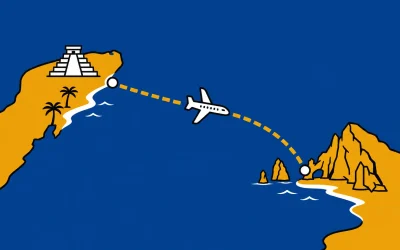

You don’t realize how big Mexico is until you try to get from Mexico City to Cancun. Suddenly “same country” feels like a long-haul trip.
Here’s exactly how far it is, how long each option takes, what it really costs in 2026, and how to choose between flying, bus, and driving—both Cancun → Mexico City and Mexico City → Cancun.
Distance Between Mexico City and Cancun: Key Facts
Exact distance in kilometers and miles
Mexico City and Cancun are on opposite sides of the country:
- Straight-line (air) distance: roughly 1,300 km / 810 miles
- Typical driving distance: about 1,600–1,650 km / 995–1,025 miles depending on route
Think of it as driving from New York to Miami or London to northern Italy in one shot.
Map and route overview
On a map, the route runs:
- From central Mexico (Mexico City, in the highlands)
- Across the Yucatán Peninsula
- To Cancun on the Caribbean coast
By road, most routes swing east through Puebla / Veracruz / Villahermosa / Campeche / Mérida before turning north to Cancun.
By air, it’s a straight jump across the country: CUN (Cancún International) ↔ MEX (Mexico City International).
Best Ways to Travel from Cancun to Mexico City (and Vice Versa)
Flying Between Cancun and Mexico City
Flying is the default choice for most people. It’s fast, frequent, and usually affordable.
Flight time and airlines in 2026
Key facts for Cancún (CUN) ↔ Mexico City (MEX) in 2026:
Airlines
- Aeroméxico
- Viva Aerobus
- Volaris
- (In some schedules, Magnicharters appears on certain dates)
- Frequency: about 23–27 nonstop flights per day
That’s roughly 158–162 flights per week, with departures from early morning until late at night.
- Typical nonstop flight time: 2h 24m to 2h 34m
Flights operate in both directions with similar timings and frequency:
Cancún → Mexico City and Mexico City → Cancún are essentially mirror routes.
How long the trip really takes (airport time included)
For planning your day, don’t just count the flying time. Use this rough door-to-gate estimate:
Domestic flight buffer
- Arrive at the airport 2 hours before departure (Mexican domestic standard in 2026)
Flight duration
- ~2.5 hours in the air for CUN–MEX
After landing
- 15–45 minutes for taxiing, disembarking, baggage claim, and getting out of the airport
So a “2.5‑hour flight” usually eats about 5 hours total from airport arrival in one city to exit in the other. Add more time if you’re far from the airport in either city.
Costs and booking tips
Recent 2026 fare snapshots for CUN–MEX:
- Cheapest one-way deals seen: about $26–$58 USD
- Typical one-way range: roughly $55–$350 USD
Depends on:
- Airline
- Season (summer and holidays cost more)
- How early you book
- Round-trip starting fares: commonly around $92–$129 USD
Monthly averages (example from Trip.com 2026 data)
- February: one-way around $58, round-trip around $101
- August: one-way around $138
- May: round-trip averages up to $224
Practical booking tips
- Book early for holidays. Christmas/New Year, Easter, summer, and long Mexican holiday weekends (puentes) push this route into high demand.
- Mix airlines. Often cheaper to fly one airline out and another back.
- Watch baggage rules. Low-cost carriers may sell very cheap base fares, then charge extra for carry-ons, checked bags, and seat selection.
- Check both directions. Oddly, Cancun → Mexico City and Mexico City → Cancun can price differently on the same dates; compare both.
Airport information and logistics
Cancún International Airport (CUN)
- Main gateway to the Riviera Maya and Cancun hotel zone.
- Busy with international tourists, especially on weekends and holiday seasons.
- Domestic flights to Mexico City usually leave from the same terminals as other national routes; check your airline’s terminal.
Mexico City International Airport (MEX – Benito Juárez)
- Located in the east of the city.
- Heavy traffic to/from the airport, especially morning and late afternoon weekdays.
- Metro, buses, authorized taxis, and app‑based rides are available; allow extra time during rush hour.
When to reach the airport
- Domestic flights: arrive 2 hours before departure
- If you’re checking bags or traveling at peak times, add another 30 minutes.
Traveling by Bus
If you want to save money or prefer ground travel, buses are the main alternative. The route is long but widely used.
Bus companies and routes
Multiple major Mexican coach companies run between Cancún and Mexico City, though exact 2026 timetables and prices vary by date and operator.
Expect services from well-known intercity brands such as:
Large national or regional coach lines departing from
- Main Cancún bus terminals
- Major Mexico City terminals (e.g., TAPO / Oriente, Norte, or other large stations)
Routes are typically direct overnight or with a small number of stops in major cities along the way (for example, in the Yucatán and Tabasco/Veracruz regions) before reaching Mexico City.
Because 2026 route-by-route timetables change frequently, check comparison or booking platforms that aggregate bus schedules in Mexico, or the official sites of major Mexican bus consortia.
Duration, cost, and comfort levels
Even without a route-specific timetable, you can use realistic long-distance Mexico bus benchmarks:
- Driving distance: about 1,600+ km
- Typical bus duration (Cancún ↔ Mexico City): often 20–24 hours total, depending on route, stops, and traffic
Ticket price range (indicative only)
- Standard/second-class: lower price, slower, more stops
- First-class / executive: higher price, faster, more comfort, more legroom, often onboard entertainment and A/C
Seats on long-distance Mexican buses are usually reclining, often 2–2 or 2–1 layout on higher-end services. Overnight services are common so you can “sleep through” most of the trip and save a night of accommodation.
Booking process and luggage policies
Buying tickets
Online
- Through bus-company websites or regional aggregators
- Lets you choose seats and see different classes
In person
- At bus stations in Cancún or Mexico City
- Same-day or advance purchase possible, but popular dates can sell out
When to book
- For regular weekdays outside holidays, booking a few days in advance is often fine.
- For Christmas, Easter, summer holidays, and long weekends, book at least 1–2 weeks ahead.
Luggage
Policies differ by company, but Mexican intercity buses usually allow:
- At least one checked bag stored under the bus
- One small carry-on or backpack in the cabin
Always confirm the exact weight and size limits with your chosen operator.
Driving the Route
Driving between Mexico City and Cancún turns the trip into a full road journey rather than a simple transfer. For some travelers, that’s exactly the point.
Distance and driving time
Using standard 2026 driving-time guidance:
- Driving distance: about 1,600–1,650 km / 995–1,025 miles
- Nonstop driving time (no long breaks): typically 18–20 hours
Calculated using:
- Long stretches of highway at 90–105 km/h (55–65 mph) average
- Slower speeds near cities and junctions
Realistically, once you add food, fuel, and rest stops, most people spread it over:
- 2 days with one overnight stop
- Or 3 days if you want time to explore en route
Recommended routes and road conditions
Route choice depends on your goals:
Fastest route
- Follows major highways and toll roads between Mexico City and Cancún
- Avoids smaller backroads and unnecessary detours
More scenic or cultural route
- Adds stops in cities like Puebla, Veracruz, Villahermosa, Campeche, or Mérida
- Extends the trip but gives you time in colonial cities, ruins, and coastal areas
General 2026 road-trip guidance:
- On long highway trips, assume an average speed of 90–105 km/h once traffic is included.
- In or near cities, or on smaller roads, actual average speed may drop to 35–45 km/h.
Use a real-time navigation app with departure time set to get the most accurate ETA; it accounts for roadworks, accidents, and rush hours.
Tips for a safe and scenic drive
- Avoid night driving on unfamiliar highways when possible.
- Plan fuel stops in advance, especially on longer stretches with few services.
- Schedule breaks every ~2 hours to stay fresh.
- Build in extra time around big cities, adding 15–30 minutes per metro area during business hours for possible congestion.
If you prefer more of a road-trip experience than a straight transfer, allocate 2–3 days, and pick a couple of overnight stops that interest you.
Alternative Transport Options
Private shuttles and transfers
On the Cancún side, private shuttles are common for links between:
- Airport ↔ hotel zone
- Airport ↔ Playa del Carmen / Tulum / Riviera Maya areas
Direct Cancún–Mexico City transfers by shuttle or private car are technically possible but generally expensive over such a long distance and often priced for groups or special tours, not regular point-to-point travel.
Car-share and ride-share
- Local car-sharing / ride-sharing apps might have occasional long-distance rides between the two cities.
- Good if you’re flexible on dates and don’t mind sharing a car with strangers.
Always check:
- Driver ratings
- Car condition
- Agreed stops and cost split
Rail options
There’s no direct, fast, intercity rail that makes Mexico City ↔ Cancun a viable train option in 2026 for most travelers. Flights, buses, and driving remain the primary choices.
Environmental Impact of Each Mode
Eco-conscious travelers often need to choose between time and emissions.
While precise route-specific CO₂ numbers aren’t available in the provided data, general 2026 travel patterns still follow this rough order for per-passenger impact:
- Flying: highest emissions per passenger for this distance, especially on short- to medium-haul flights.
- Private solo driving: high per-person emissions unless you have multiple passengers.
- Carpooling (full car): shared impact per head drops significantly.
- Coach bus: usually the lowest emissions per passenger, since many people share one vehicle over a long route.
If environmental footprint is a priority:
- Choose the bus, or
- Share a car with several people rather than flying or driving alone
- If you fly, look for nonstop flights (which are more efficient than routes with layovers) and consider carbon-offset options if that aligns with your values.
Comparing Travel Options: What’s Best for You?
Here’s a simple comparison to help you weigh the main choices in 2026.
| Mode | Typical Time (door to door) | Approx. Cost Range* | Comfort & Experience | Best For |
|---|---|---|---|---|
| Flight | ~5 hours total | ~$55–$350 one-way | Shortest trip, modern airports, quick hop | Time-sensitive, short trips |
| Bus | ~20–24 hours | Lower than flying in many cases | Reclining seats, overnight, more downtime | Budget, no-rush, eco-minded |
| Driving | 2–3 days with stops | Fuel, tolls, car rental | Full flexibility, road-trip feel | Explorers, families, long holidays |
*Exact fares and costs vary by date, class, and booking platform.
Budget vs. time vs. comfort
Fastest
- Fly. Even with airport time, it’s far quicker than any ground option.
Cheapest overall
- Often a bus ticket or carefully timed low-cost airline sale, especially if you don’t have checked bags.
Most flexible
- Driving your own or rented car. You control timing and stops.
Most comfortable long-haul overnight
- High-end executive bus can be surprisingly comfortable for the price.
Family travel considerations
With small kids
- A 2.5‑hour flight plus some airport hassle is usually easier than keeping them entertained on a 20‑hour bus.
With teenagers or adults
- Overnight bus can work if everyone can sleep in reclining seats.
Driving with a family
- Great if you split the drive over a couple of days and treat it as a trip, not just transportation.
Eco-friendly travel recommendations
Best balance for many eco-focused travelers
- Coach bus in one direction, flight in the other.
For maximum emissions reduction
- Bus both ways, or
- Carpool in a full vehicle and avoid unnecessary detours.
Travel Tips and Safety Advice for the Mexico City–Cancun Route
Safety tips per travel method
Flights
- Use authorized airport taxis or reputable ride apps at both ends.
- Keep valuables in your carry-on, not in checked luggage.
- Watch your bags in check-in lines and arrivals halls.
Buses
- Pick well-known operators rather than very cheap unknown options.
- Keep valuables on you or in a small daypack you can keep at your feet.
- Avoid leaving electronics in the overhead rack while you sleep.
- Use bus company terminals instead of informal pickup points when possible.
Driving
- Stick to major highways and toll roads where available.
- Avoid driving long unfamiliar stretches in the middle of the night.
- Don’t leave valuables visible inside the car.
- Keep fuel above a comfortable level; don’t rely on a single station being open.
Seasonal advice: when to travel and what to avoid
High season in Cancun
- December–April and school holidays. Flights cost more and airports are busier.
Hurricane season (Caribbean side)
- Typically June–November, with peak in late summer and early fall.
- Flights can face weather-related delays or cancellations during storms.
Major Mexican holidays
- Easter (Semana Santa), Christmas/New Year, and long weekends
- Expect crowded buses, busy highways, and higher prices.
If flexibility matters more than a specific date, avoid peak holiday weeks to save time and money.
Health and COVID-19 considerations in 2026
By 2026, many countries, including Mexico’s key partners, have dropped most COVID-specific entry requirements, such as mandatory vaccination proof or pre-departure tests, for general travelers according to the sources you provided about U.S., EU, and Canada travel rules.
Still, health and safety advisories can shift:
- Check your home country’s travel advisory site (for example, U.S. State Department-style advisories) for current security or health alerts related to Mexico.
- Confirm airline and bus company rules on masks or health protocols, as companies can keep their own policies even when governments relax restrictions.
FAQs About Traveling Between Mexico City and Cancun
How far is Mexico City from Cancun by air?
About 1,300 km / 810 miles in a straight line.
How far is it by road?
Roughly 1,600–1,650 km / 995–1,025 miles, depending on the exact driving route.
How long is the flight from Cancun to Mexico City?
Nonstop flights usually take about 2h 24m to 2h 34m in the air. With airport time, plan on around 5 hours total.
Which airlines fly Cancun ↔ Mexico City in 2026?
Main carriers on this route include Aeroméxico, Viva Aerobus, and Volaris, with some schedules also listing Magnicharters.
How much does a flight cost?
Typical one-way fares run roughly $55–$350 USD, with cheap deals as low as $26–$58 in some recent searches and many round-trips starting around $92–$129.
Is the bus cheaper than flying?
Often, yes—especially outside peak travel dates. Buses trade time (around 20–24 hours) for savings and lower environmental impact.
Is driving from Mexico City to Cancun safe?
Plenty of people drive the route. Use main highways and toll roads, avoid unnecessary night driving, and plan rest and fuel stops sensibly.
Can I buy tickets online?
Yes. Flights and many buses can be booked online through airline sites, bus companies, and comparison platforms. You can also buy bus tickets at major terminals.
How long should I book in advance?
- For flights during busy seasons: several weeks ahead.
- For buses on regular days: a few days is often enough; during holidays, aim for 1–2 weeks.
Does any train go from Mexico City to Cancun?
There’s no fast, direct long-distance train connecting the two cities as a practical alternative in 2026.
Final Thoughts: Planning Your Next Trip
Mexico City and Cancun feel worlds apart, but once you understand the distance—roughly 1,600+ km by road and 2.5 hours by air—your choices become straightforward. Fly when time matters, bus when cost and emissions matter, and drive when the journey is part of the vacation.
Next step: decide what you value most (speed, price, or experience), then:
- Check current flight fares and bus schedules for your dates.
- Compare one-way vs. round-trip and different airlines / bus classes.
- Lock in your choice early if you’re traveling in high season.

Alison is a travel writer passionate about solo adventures, photography, and memorable getaway escapes. She loves uncovering Cancun’s scenic coastline, boutique stays, local experiences, and hidden gems, creating stories that help curious travelers see more than the usual tourist highlights. Her work has been featured in Forbes, CNN, Travel + Leisure, Yahoo, and other major outlets.