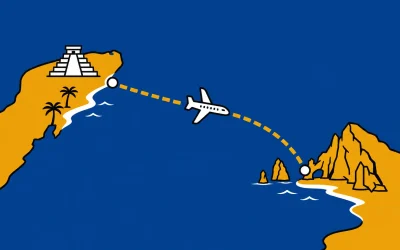

You can fly from Cancun to Cuba in less time than many people spend in airport security lines. The countries feel close on a map, but the real question is how that distance translates into time, cost, and logistics in 2026.
You’ll find clear answers here: exact distance in km and miles, current flight options, realistic travel times and price ranges, required documents, and practical tips to plan a smooth Cancun–Cuba trip.
Understanding the Distance Between Cancun and Cuba
Cancun and Cuba look almost side by side on the Caribbean map. The exact numbers help you decide if the hop is worth building into your itinerary.
Straight-line distance
For most travelers, Havana is the reference point.
Cancún → Havana straight-line distance
≈ 509–510 km | ≈ 316–317 miles
Some sources also give a more general distance from Cancun to a reference point in Cuba:
Cancún → general Cuba reference (near Isle of Youth)
≈ 764 km | ≈ 475 miles
Use the Havana figure if you care about the capital. The larger number reflects a different Cuban reference point, not Havana itself.
| Route reference | Distance (km) | Distance (mi) |
|---|---|---|
| Cancún → Havana | 509–510 | 316–317 |
| Cancún → Cuba ref. point* | 764 | 475 |
*Cited in some tools as a generic “Cancun–Cuba” distance, based on a point near the Isle of Youth.
Approximate travel routes and distances
Real journeys don’t follow perfect straight lines, but the extra distance in the air is modest.
- Nonstop flights between Cancún and Havana run close to the great-circle path, so flight distance is only slightly higher than the 510 km line.
- One-stop itineraries (for example via Mexico City, Miami, or Panama City) can multiply both distance and time, since you’re adding a leg that’s not remotely “as the crow flies.”
On the ground or by sea there’s no practical scheduled route in 2026 between Cancun and Cuba, so air distance is the only figure that really matters for trip planning.
Best Ways to Travel from Cancun to Cuba
The short answer: by air. Everything else is either unofficial, private, or unrealistic for most people.
Flights: direct and connecting options
Main airports on this route
- Cancún International Airport (CUN) – Mexico’s Caribbean hub.
- Havana José Martí International Airport (HAV) – Cuba’s main gateway.
- Camagüey Ignacio Agramonte International Airport (CMW) – gateway for central/eastern Cuba.
These are the key points for current Cancun–Cuba links in 2026.
Direct flights in 2026
Based on the latest 2026 route information:
- Cancún ↔ Havana (CUN–HAV)
Airlines
- VivaAerobus
- Euroairlines
- Cancún ↔ Camagüey (CUN–CMW)
Airline
- VivaAerobus
Flight schedules change often, so always check live data when you book, but these carriers are currently listed as operating direct services on these routes.
Connecting flight options
If direct seats are sold out, seasonal, or not matching your dates, you’ll often see one-stop itineraries via third-country hubs.
Common airlines that appear in 2026 searches for Cancun–Cuba trips (often via hubs like Miami, Panama City, Mexico City, Nassau) include:
- American Airlines
- Delta Air Lines
- Copa Airlines
- Aeroméxico
- Bahamasair
- Canadian carriers in the mix for broader Cuba connectivity: Air Canada, WestJet, Air Transat, Sunwing
Some of these may not operate a strict “CUN–Cuba” ticket but rather connect you via hubs where you change planes.
For live options, using aggregators like Skyscanner, Kayak, or airline sites directly is essential. But the pattern is clear: direct low-cost Mexican/European carriers, plus legacy airlines via hubs.
Other travel methods: ferries, boats, and alternatives
Ferries between Cancun and Cuba
As of 2026, there is no scheduled public ferry operating between Cancún and Cuba.
Available ferry data in 2026 sources refers to completely different regions (for example, Amalfi Coast routes in Italy), not the Yucatán–Cuba corridor. Those don’t apply here.
So if you’ve heard rumors of a “Cancun–Havana ferry,” that’s not a standard, bookable service in 2026.
Private boats and charters
In practice:
- Private yacht charters and sailing boats may cross between Mexico and Cuba, but:
- They’re expensive.
- They require serious planning, permits, and an experienced crew.
- You must handle immigration and customs formalities in both countries at approved ports.
For most travelers, this is more expedition than transportation. Treat it as a bespoke adventure, not a typical travel option.
Overland or indirect alternatives
You can’t “drive” to Cuba. Any overland idea still ends in a flight or private sea crossing at some point.
So for 99% of people asking “how far is Cuba from Cancun,” the meaningful option is: fly.
Travel Duration and Costs Comparison
You know the distance. Now you need to know what that feels like in hours and dollars.
Flight times and price ranges
Flight duration: Cancun–Cuba
The straight-line distance of about 510 km (316 mi) is short for aviation standards.
Typical air time on direct flights:
- Cancún → Havana: about 1 hour 10 minutes to 1 hour 30 minutes in the air, depending on routing and winds.
- Cancún → Camagüey: slightly longer, but still in the ballpark of under 2 hours of air time.
To plan realistically, use the common 2026 timing guidelines:
- Add about 18 minutes for average arrival delay to the published flight time.
Add airport buffers
- 2–3 hours before departure for an international flight.
- Extra margin for immigration on arrival in Cuba.
So while the flight itself is around 1.5 hours, your airport-to-airport process is more like 4–5 hours when you factor in check-in, security, and potential delay.
Price ranges in 2026
We don’t have a dedicated Cancun–Havana fare dataset, but we can position it against general 2026 airfare trends.
From 2026 U.S. and short-haul data:
- Average one-way ticket across U.S. routes: about $300–$305.
General pattern
- Budget one-way deals (short-haul): around $50–$150 on sale or low-cost carriers, before bags and extras.
- Common short-haul international one-way: starting around $250, often going well above $600 depending on dates, season, and demand.
For Cancún → Havana / Camagüey, a realistic mental range:
- Bare-minimum promo or low-cost prices: can dip below $150 one-way in shoulder seasons or sales.
- More typical short-haul international fares: $250–$400+ one-way.
- Peak dates / last-minute: can spike above $400–$600 one-way.
Always check baggage rules. Low sticker prices often exclude checked bags and sometimes even carry-ons.
Cost analysis of different travel modes
| Mode | Time (in-air/at sea) | Realistic total trip time* | Typical 2026 cost range (one-way) |
|---|---|---|---|
| Direct flight CUN–HAV/CMW | ~1–2 hours | ~4–5 hours | Roughly $150–$400+ |
| One-stop flight via hub | 4–10+ hours | 6–14+ hours | Often $250–$600+ |
| Private boat / charter | Many hours to days | Depends on vessel | Highly variable, usually high |
*Door-to-door airport time, not including travel from your hotel to the airport.
In short: direct flights are both the fastest and, in almost all cases, the cheapest realistic option.
Travel Requirements and Documentation in 2026
Distance is meaningless if you’re turned away at check-in. Documentation is where many Cancun–Cuba plans go wrong.
Visa and entry requirements
Requirements vary by nationality, not by your departure point. Always check:
- Your country’s official travel site (e.g., U.S. Department of State, UK FCDO, Canada Travel Advisory).
- Official Cuban consular or tourism pages.
General patterns that remain relevant in 2026:
Passport
- Valid passport is mandatory for entry into both Mexico and Cuba.
- Many countries require at least 6 months’ validity beyond your travel dates; aim to meet that.
Cuba tourist card / visa
- Most travelers need a Cuban tourist card (tarjeta turística) or visa category appropriate to their trip purpose.
- Airlines often check this before boarding in Cancún.
- Some airlines or agencies bundle the tourist card into the ticket; others require you to purchase it separately at the airport or online.
Mexico exit/entry rules
- If you’re already in Cancún, you likely entered Mexico under a tourist regime that sets a maximum stay length. Make sure a Cuba side-trip still keeps you within your allowed Mexico stay when you return.
- Keep your FMM/tourist record or any entry document safe for re-entry if needed.
For U.S. citizens, rules for Cuba are extra complicated (categories of authorized travel, records of activities, etc.). That’s a specialized topic and should be checked directly on U.S. government sites and with your airline at the time of booking.
Health and safety protocols
By 2026, COVID-era rules are far more relaxed than at their peak, but public health requirements can change quickly.
Before you fly:
Check if Cuba requires
- Proof of vaccination or negative tests.
- Health insurance that covers care in Cuba (this has been a recurring requirement; airlines sometimes include a basic policy in the ticket, but not always).
- Confirm Mexico’s re-entry rules if you’re returning there after Cuba.
Health forms and entry rules often change with short notice. Use:
- Your airline’s “travel requirements” tool.
- Official government and embassy sites for Cuba and Mexico.
Practical Travel Tips for Cancun to Cuba Journeys
With the basics covered, here’s how to turn a simple hop into a smooth trip instead of a headache.
Booking strategies for best deals
- Aim for 1–3 months out.
Short-haul international flights often price best several weeks to a couple of months before departure, not on day one or the day before.
- Use price alerts.
Set alerts on tools like Skyscanner, Google Flights, or Kayak for CUN–HAV and CUN–CMW and watch trends for a week or two before locking in, unless you’re traveling peak season.
- Check direct vs. one-stop.
Low-cost carriers like VivaAerobus can undercut legacy airlines on direct routes. Compare:
- One-way direct on VivaAerobus or Euroairlines.
- One-stop options on American, Delta, Copa, Aeroméxico, etc.
- Be flexible on days.
Midweek flights often cost less than weekend departures. Shifting your itinerary by 1–2 days can pay off quickly.
- Watch baggage fees.
A “$90 ticket” that charges $35 per bag each way can end up more expensive than a $150 fare with a checked bag included.
- Consider multi-city planning.
If you’re doing a Yucatán + Cuba combo, compare:
- One ticket into Cancún and out of Havana (or vice versa).
- Simple round-trip to Cancún plus separate Cancun–Cuba round-trip.
Use a few test itineraries; the cheapest option isn’t always the most obvious one.
Seasonal considerations and weather impacts
You’re flying across hurricane country. Timing matters.
Hurricane season
- Officially June 1 to November 30, with higher storm risk roughly August–October.
- Expect a greater chance of delays, cancellations, and re-routing in that window.
- If traveling then, build buffer days into your plan and keep your itinerary changeable.
Dry vs. wet seasons
- Dry/high season: roughly December to April. Pleasant weather, but higher prices and more crowds on both sides.
- Rainier months: roughly May to October. Warmer, more humid, more thunderstorms, often cheaper airfares and hotels.
Holiday peaks
- Christmas/New Year, Easter/holy week, and major local holidays can send fares and hotel prices soaring between Mexico and Cuba.
Book earlier and expect fewer deals around those dates.
Safety and travel advisories
Both Mexico and Cuba have regional safety issues, but millions of tourists travel safely every year with basic precautions.
Key steps:
Check your country’s official travel advisory for
- Security conditions in Cancún / Quintana Roo.
- Current advisories for Cuba.
- Register your trip if your government offers a traveler program.
Use common sense
- Avoid flashing valuables.
- Use licensed taxis or known ride services where available.
- Keep copies (digital and paper) of your passport, tickets, and insurance.
For Cuba in particular, keep an eye on advisories about fuel availability, cash/ATM access, and internet connectivity, which can affect daily travel logistics.
FAQs About Traveling from Cancun to Cuba
How many kilometers/miles is Cuba from Cancun?
- Cancún to Havana: about 509–510 km (about 316–317 miles).
- A broader Cancun–Cuba reference point is about 764 km (about 475 miles), but that’s not Havana.
Are there direct flights from Cancun to Cuba?
Yes. As of 2026, VivaAerobus and Euroairlines operate direct flights between Cancún and Havana, and VivaAerobus flies direct between Cancún and Camagüey.
How long does a flight from Cancun to Cuba take?
Roughly 1 hour 10 minutes to 1 hour 30 minutes in the air to Havana, usually under 2 hours to Camagüey.
What’s the cheapest way to travel from Cancun to Cuba?
In practical terms, a direct low-cost flight is the cheapest viable option. There’s no public ferry, and private boats cost far more than flights.
Are there ferry or boat options for traveling from Cancun to Cuba?
No scheduled public ferry runs this route in 2026. Any boat journey would be via private charter or yacht, which is expensive and logistically complex.
What travel documents are required between Mexico and Cuba in 2026?
You’ll need a valid passport and, for most travelers, a Cuban tourist card or visa. Check your nationality’s specific rules on official government and Cuban consular sites.
Are there health or vaccination requirements currently in place?
Rules change. Check shortly before travel for:
- Any vaccination or testing rules for Cuba.
- Insurance requirements, often including health coverage in Cuba.
What airports serve travelers between Cancun and Cuba?
Primarily:
- Cancún International Airport (CUN)
- Havana José Martí International Airport (HAV)
- Camagüey Ignacio Agramonte International Airport (CMW)
Are there any travel restrictions or advisories I should be aware of?
Yes, especially for:
- U.S. citizens regarding travel to Cuba categories and regulations.
- General safety and health advisories for both countries. Always consult your government’s latest travel advisory.
How far in advance should I book flights?
For this short-haul route, 1–3 months ahead is a good target, earlier for holiday peaks or if you need specific dates and times.
Do time zones differ between Cancun and Cuba?
Often they’re the same or only one hour apart, depending on daylight saving and current government policies. Always confirm your flight’s local times when booking and again before departure.
What is the best season to travel between these destinations?
For a balance of weather and stability, December to April is usually the sweet spot, avoiding the most active part of hurricane season and giving you drier conditions on both sides of the Caribbean.
Conclusion: Planning Your Trip Efficiently
Cuba sits only about 510 km (317 miles) from Cancún, and with a 1.5-hour flight, it’s one of the easiest international side-trips you can bolt onto a Mexican Caribbean vacation. The challenge isn’t distance; it’s getting the documents, timing, and booking strategy right.
To move from idea to ticket:
- Pick your Cuban city (Havana or Camagüey for direct routes).
- Check visa and health rules for your nationality.
- Set price alerts for CUN–HAV (and CUN–CMW if relevant) and aim to book 1–3 months ahead.
- Avoid the peak of hurricane season if your dates are flexible.
Then build out the fun parts: where you’ll stay, what you’ll see, and how you’ll split your days between white-sand Mexico and classic Cuba streets.

Alison is a travel writer passionate about solo adventures, photography, and memorable getaway escapes. She loves uncovering Cancun’s scenic coastline, boutique stays, local experiences, and hidden gems, creating stories that help curious travelers see more than the usual tourist highlights. Her work has been featured in Forbes, CNN, Travel + Leisure, Yahoo, and other major outlets.